Showing posts with label Environment. Show all posts

Tuesday, October 17, 2006

Curitiba Brazil: Model Sustainable City


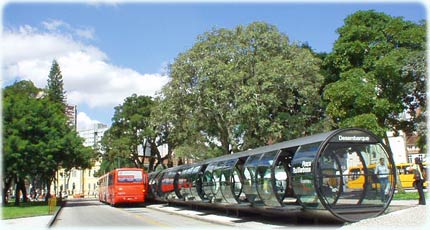
As I just completed some research on sustainable cities, I thought I would include an excerpt here from my paper (minus the diagrams). I won't bore everyone with the theoretical basis of sustainable cities, but you'll get the idea by reading this section about the city of Curitiba, Brazil, which is generally acknowledged to be one of the most sustainable cities in the world. This fact is even more remarkable when one considers that it is quite a poor city, yet has managed to achieve more sustainability than cities in the global North through innovative means. For example, the pic above is of bus 'boarding tubes'. When you're waiting for the bus (which isn't a long wait), you enter your token to get into this tube. This saves precious time, as when the bus gets there, everyone is ready to just get on without fare-paying delays. Enjoy!

Case Study: Curitiba, Brazil
At this point, it will be very useful to examine the sustainable city initiatives of a particular city in order to further illustrate the previous theoretical points. Rabinovitch (1992) notes several historical facts about the development of Curitiba’s sustainable policies and structure. The city of Curitiba is located in South Brazil, and has been both a political and administrative centre for a many years. During the 1960’s, planners made a conscious decision to prioritize public transit over the car, focus on hundreds of small projects (while avoiding large expensive ones) and discourage new developments downtown. The goal was to encourage urban expansion along the transit lines (which extend outward from the downtown), which would leave the downtown area’s history preserved, and allow more public space for citizens. Thus, a more transit and pedestrian friendly city was created.

There are several specific features of Curitiba which deserve further examination (see Figure 3 for a complete list).

First, the city’s heritage has been preserved in its architecture. Local government allowed businesses to utilize historic buildings with the condition that the building was not substantially physically changed. Thus, a theatre now sits in a building which was once a gunpowder arsenal.

Second, lest the reader think that a sustainable city cannot have industry, it should be noted that the city also has an industrial area, which is not isolated but contains housing, schools, green space, etc. Industries must adhere to strict environmental regulations. (Rabinovitch, 1992).

Third, Curitiba provides many services (delivered in an inexpensive, innovative and sustainable fashion) to their citizens. Rabinovitch (1992) notes that their water sanitation system, which uses a system of local lagoons for filtration, is cheap, effective and uses the local ecosystem. Many environmental education programs have been implemented in poor areas, and old city buses are used as mobile learning centres to teach adults useful trades. Basiago (1999) describes a program in which the poor can exchange six bags of garbage for healthy groceries, thus combating urban starvation and keeping the city clean. With recycling, and equally innovative approach was taken: the local government asked citizens to separate wet from dry garbage. The government then set up plays at local schools featuring the “Leaf Family” to show kids how to recycle. Thus, kids consider recycling fun, and encourage their families to participate. The author also observes that the local government ensures that the basic needs of the poor are met by providing free dental and health care. Further, free child care is provided to allow parents to work, which has resulted in a significant decline in infant mortality rates.

Fourth, the many green areas not only provide aesthetic value, but also act to control flooding. (Rabinovitch, 1992). Curitiba has taken many measures to encourage green space such as creating ‘green zones’, building a botanical park downtown, and passing laws to discourage cutting down trees while mandating that two trees must be planted for each one cut down. (Basiago, 1999).

Fifth, strong local governance and active citizen participation are encouraged. The mayor of Curitiba has noted that “….we take the administration to the community and promote administrative decentralization, cutting red tape and serving the people” (Alberti & Dos Santos, 1996, p. 438)

Finally, the pride and joy of Curitiba is their transit system. The choice to use only buses proved to be exceedingly practical and economical for Curitiba (see Figure 4). Not only have they implemented a bus system with many desirable features, but it is well integrated into land use planning and zoning. For example, only high rises are allowed to be built along major bus routes, and the bottom two floors of these must contain stores. Thus, residents need to travel less for shopping, many residents have easy access to transit and it provides local employment. The express buses travel in bus-only lanes, and are supplemented by local and downtown routes. In addition, passengers pay their fare while waiting for the bus, which makes the boarding process faster and more efficient (Basiago, 1999). Rabinovitch (1992) adds that one fare is valid for all types of buses, making travel much more convenient. Consequently, two-thirds of the population uses transit and this popularity allows it to pay for itself (Basiago, 1999). Thus, “Curitiba’s public transportation system is directly responsible for the city having one of the lowest rates of ambient air pollution in Brazil….residents spend only about 10% of their income on transport, which is a relatively low proportion for Brazil”. (Rabinovitch, 1992, p. 66).


References:

Alberti, M & Ricardo Dos Santos, C. (1996). Interview with the Mayor of Curitiba on Habitat II. Environmental Impact Assessment Review, 16, pp. 435-438.

Basiago, A.D. (1999). Economic, Social and Environmental Sustainability in Development Theory and Urban Planning Practice. The Environmentalist, 19, pp. 145-161.

Rabinovitch, J. (1992). Curitiba: Towards Sustainable Urban Development. Environment and Urbanization 4(2), pp. 62-73.

Friday, October 13, 2006

Douglas Tompkins' Conservation: Good or Evil?


This morning on the CBC Radio One show The Current, I heard a piece about Douglas Tompkins, a San Franscisco millionaire. Seems he has been buying huge tracts of land in Chile and Argentina and turning them into nature reserves. Sounds great, no?

Not for everyone; the local people have big problems with this. So, here comes the rich, white, male foreigner into their country, buys their land, and tells them what to do with it. Not too crowd-pleasing. In some things I have heard, the media seems to be implying that the locals do not know enough about conservation, and this is why they disapprove of his project. How about the truth? That these countries are sick and tired of the West telling what to do, how to do it, and that they will be better off if they just listen. Sounds like the usual colonial, condescending attitude of the West to me.

Naturally, the local forest and other resource extraction industries are against this. But isn't it good to save the forests from destruction? But isn't it bad to take away the livlihood of the local people? Here we have the main problem in resource management.

My suggestion: by all means turn them into reserves, but the least he can do is help the government set up employment initiatives for jobs in or around the reserve, so that the locals will actually have a good reason to support it. As it is, they just see another white guy taking away their livlihood.

Having been in Environmental Studies for a few years now, it has come to my attention that the majority of the environmental movement (in Canada anyway) is middle class and white. Many such individuals (and this is a very general statement here, before anyone gets upset)are not able to see the vailidity in the above argument that I'm making. They would say that its our job to tell 'these people' how to take care of their environment....yes, the same people that live closer to it that we do by a mile. If Tompkins really wanted to help alleviate the situation, he could still create the reserves in close collaboration with local governments and the public to come up with a 'made locally' solution. But no, since its his money, he must have the final say on how it is spent, no? Ridiculous.

Here this segment of The Current here.

Monday, October 02, 2006

Be cool, get rid of your car!

I was very pleased to read a recent article by Martin O'Malley which extolls the virtues, frugality and fun of not having a car. Here is an excerpt:

"I have become a better person by not owning a car. Jostling with other humans on the subway and on city sidewalks brings me new experiences every day that I would not enjoy locked inside a hermetically sealed automobile. I’m convinced what many car-owners most enjoy about driving their cars is the delightful privacy in lives otherwise fettered to jobs and families. In the lush privacy of their automobiles, even on hour-long commutes, they can listen to their favourite music, follow sports, smoke and chat on their cellphones."

Read the whole article here.

Saturday, September 09, 2006

The Waspinator

I happened across this product, the Waspinator, which claims to keep wasps away. Its basically a replica of a wasps' nest, which apparently keeps other wasps away, because they think that they have come across an enemy wasp nest in their midst. I love these products: the ones that actually use animal knowledge to come up with a simply solution, instead of simply killing them or using harsh chemicals which are harmful to other creatures (us included) as well. Happy fall picnicing!

Tuesday, July 18, 2006

Darth Vader Ants?


I have developed a recent fascination with ants, which led me to the discovery of the so-called "Darth Vader" Ant. You can be the judge, from the pic above. They have this helmet-like structure around their head, and they have spikes along their bodies. Its a South American ant (where all the most developed and large insects come from), and has recently been discovered exhibiting gliding behaviour. Apparently, if dropped from a tree, these ants can do a turn in mid-air and come back to the tree trunk. This supposedly protects them from falling to the forest floor (almost certain death), and allows them to find the branch where they nest. Neat. See the 4 minute video here and learn more here.

I have this theory that one day, cockroaches and ants will take over the world. Ants have the social organization and strength, and cockroaches have the staying power. Don't think humans will be around to see it though. Maybe Speilberg will make a sci-fi film about it. Chris told me the other day that the film Them is hilarious (in a way that only horror films from the 50's can be). I'll have to check it out one day....

Thursday, June 01, 2006

Nuts to Drivers Licenses!

Today I read an article in Spacing (by Liz Worth) which discusses the allure of getting (and keeping) driver's license. It goes over the fact that when you turn 16 there is this imperative to get a driver's license because it represents freedom and independence, even if parking and getting around in downtown Toronto in a car is more difficult than taking the TTC. The author mentions that many people eventually come to the conclusion that the latter issues are too problematic, and start taking the TTC or biking again. The paragraph that got my attention:

"Now, driver's licenses sit expired in friends' wallets, and come out only for comic relief when they feel like showing off some bad pictures."

I was so happy to see this. I sometimes feel like a second class citizen because my license has been expired for many years now, so I can't really use it for identification. Because my passport is also expired at the moment, and I still have one of the old health cards (without the photo), I sometimes find myself unable to prove that I am who I say (and know) I am. Having an expired license also means the odd lecture from my parents about how I should "really take care of that", etc. Kudos to Spacing for legitimizing us folk who have deliberately let their licenses expire, and instead, can enjoy the streetscape on a much different (and, I would argue, more enjoyable) level than drivers.

Monday, May 29, 2006

TTC Strike and Cormorants

This pic was taken today at the lonely looking Ossington Station. Usually this shot would have been crowded with buses.

It looks like the short-lived TTC strike is over, so I'm sure that most stations are bustling once more by now. I was quite surprised to hear Mayor Miller strongly condemn the strike today, in his 3 pm press conference. He argues that the appropriate response from the TTC union in such a situation would have been to work with the TTC management to resolve the problem. I would agree that this is ideally the best route, but when is a situation ever ideal? The recent TTC announcement that TTC employees should exercise discretion with respect to fare collection, coupled with the even more recent announcement that many TTC cleaning and track maintenance staff would be switched to permanent night shifts (from their current day shifts), on top of the usual TTC mismanagement of staff has brought us to this. The TTC management is notoriously difficult to deal with, but the union always gets the blame. Ask any TTC employee: they will tell you that this has been brewing for some time. These recent events were just the catalyst. So, while I don't think that anyone wanted this strike to happen (especially considering that today is the hottest day of the year so far and the first heavy smog day) this is desperation in action. Unfortunately this strategy often backfires: instead of gaining public support for their cause, such strikes (especially ones with little warning like this one) result in increased animosity toward TTC employees. Perhaps tomorrow, when service has resumed as usual, people will take advantage of the "discretionary" fare collection, and act belligerently to the staff to make up for the inconveniences they had to suffer today.

Its a fact: some animals are more media savvy than others. When the public sees baby seals getting killed its a catastrophe, but other animals, such as cormorants, have little such support. A couple of years ago the province started a cormorant cull (a much nicer word than massacre isn't it?). But today, the Toronto Star is reporting that many cormorants are being left to die a painful and lingering death instead of being humanely killed. I strongly agree with Rob Laidlaw, who notes that if people saw deer (who the province also culls) left to die with their legs blown off, there would be an uproar.