Showing posts with label Politics. Show all posts

Wednesday, December 20, 2006

Homeless Funding Now!


A couple days ago I attended a protest outside of Jim Flaherty's office (federal finance minister) to protest the massive cuts to homeless programs and funding. Although we could not get in to see the minister (there was heavy security both inside and outside the Sunlife building), we did have a good picket outside, and a turkey lunch was served. Here are some pics from the event.

Monday, October 23, 2006

No Seats? Greyhound Says "Free Ride"!


On the weekend my partner and I went to visit his parents in lovely Fergus Ontario. For our return trip, we boarded a Greyhound bus at the Guelph bus terminal. We were surprised to see how full the bus was for 9:20 on a Sunday night, but we didn't expect it to be totally full, which in fact, it was. We managed to get seats, but when we made the next stop at the University of Guelph, there was only one seat left, and several passengers waiting.

Here's the surprise: the bus driver advised the waiting passengers that they could either wait for the next bus (about an hour later), or ride standing, and the ride would be FREE! I was amazed by this, as I had always understood that in this situation, Greyhound would simply call for more buses to deal with the extra passengers. I'm not sure whether this is Greyhound policy, or if it is up to the discretion of the driver, but I was most pleased. I'm sure that (what I assume were) Guelph students didn't mind standing to save about $15. Somehow, I can't imagine Go Transit doing this.


This reminded me of the victory for the Bus Rider's Union in Los Angeles, which insisted that people were not sardines, and should not be packed into overcrowded buses. They demanded from the Metro Transit Authority that if there were no seats on the bus, they shouldn't have to pay the fare. This was especially salient because the reason buses were so overcrowded was that the MTA was not fully servicing minority and poor areas of L.A.

Tuesday, October 17, 2006

Curitiba Brazil: Model Sustainable City


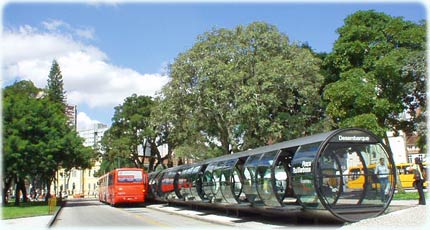
As I just completed some research on sustainable cities, I thought I would include an excerpt here from my paper (minus the diagrams). I won't bore everyone with the theoretical basis of sustainable cities, but you'll get the idea by reading this section about the city of Curitiba, Brazil, which is generally acknowledged to be one of the most sustainable cities in the world. This fact is even more remarkable when one considers that it is quite a poor city, yet has managed to achieve more sustainability than cities in the global North through innovative means. For example, the pic above is of bus 'boarding tubes'. When you're waiting for the bus (which isn't a long wait), you enter your token to get into this tube. This saves precious time, as when the bus gets there, everyone is ready to just get on without fare-paying delays. Enjoy!

Case Study: Curitiba, Brazil
At this point, it will be very useful to examine the sustainable city initiatives of a particular city in order to further illustrate the previous theoretical points. Rabinovitch (1992) notes several historical facts about the development of Curitiba’s sustainable policies and structure. The city of Curitiba is located in South Brazil, and has been both a political and administrative centre for a many years. During the 1960’s, planners made a conscious decision to prioritize public transit over the car, focus on hundreds of small projects (while avoiding large expensive ones) and discourage new developments downtown. The goal was to encourage urban expansion along the transit lines (which extend outward from the downtown), which would leave the downtown area’s history preserved, and allow more public space for citizens. Thus, a more transit and pedestrian friendly city was created.

There are several specific features of Curitiba which deserve further examination (see Figure 3 for a complete list).

First, the city’s heritage has been preserved in its architecture. Local government allowed businesses to utilize historic buildings with the condition that the building was not substantially physically changed. Thus, a theatre now sits in a building which was once a gunpowder arsenal.

Second, lest the reader think that a sustainable city cannot have industry, it should be noted that the city also has an industrial area, which is not isolated but contains housing, schools, green space, etc. Industries must adhere to strict environmental regulations. (Rabinovitch, 1992).

Third, Curitiba provides many services (delivered in an inexpensive, innovative and sustainable fashion) to their citizens. Rabinovitch (1992) notes that their water sanitation system, which uses a system of local lagoons for filtration, is cheap, effective and uses the local ecosystem. Many environmental education programs have been implemented in poor areas, and old city buses are used as mobile learning centres to teach adults useful trades. Basiago (1999) describes a program in which the poor can exchange six bags of garbage for healthy groceries, thus combating urban starvation and keeping the city clean. With recycling, and equally innovative approach was taken: the local government asked citizens to separate wet from dry garbage. The government then set up plays at local schools featuring the “Leaf Family” to show kids how to recycle. Thus, kids consider recycling fun, and encourage their families to participate. The author also observes that the local government ensures that the basic needs of the poor are met by providing free dental and health care. Further, free child care is provided to allow parents to work, which has resulted in a significant decline in infant mortality rates.

Fourth, the many green areas not only provide aesthetic value, but also act to control flooding. (Rabinovitch, 1992). Curitiba has taken many measures to encourage green space such as creating ‘green zones’, building a botanical park downtown, and passing laws to discourage cutting down trees while mandating that two trees must be planted for each one cut down. (Basiago, 1999).

Fifth, strong local governance and active citizen participation are encouraged. The mayor of Curitiba has noted that “….we take the administration to the community and promote administrative decentralization, cutting red tape and serving the people” (Alberti & Dos Santos, 1996, p. 438)

Finally, the pride and joy of Curitiba is their transit system. The choice to use only buses proved to be exceedingly practical and economical for Curitiba (see Figure 4). Not only have they implemented a bus system with many desirable features, but it is well integrated into land use planning and zoning. For example, only high rises are allowed to be built along major bus routes, and the bottom two floors of these must contain stores. Thus, residents need to travel less for shopping, many residents have easy access to transit and it provides local employment. The express buses travel in bus-only lanes, and are supplemented by local and downtown routes. In addition, passengers pay their fare while waiting for the bus, which makes the boarding process faster and more efficient (Basiago, 1999). Rabinovitch (1992) adds that one fare is valid for all types of buses, making travel much more convenient. Consequently, two-thirds of the population uses transit and this popularity allows it to pay for itself (Basiago, 1999). Thus, “Curitiba’s public transportation system is directly responsible for the city having one of the lowest rates of ambient air pollution in Brazil….residents spend only about 10% of their income on transport, which is a relatively low proportion for Brazil”. (Rabinovitch, 1992, p. 66).


References:

Alberti, M & Ricardo Dos Santos, C. (1996). Interview with the Mayor of Curitiba on Habitat II. Environmental Impact Assessment Review, 16, pp. 435-438.

Basiago, A.D. (1999). Economic, Social and Environmental Sustainability in Development Theory and Urban Planning Practice. The Environmentalist, 19, pp. 145-161.

Rabinovitch, J. (1992). Curitiba: Towards Sustainable Urban Development. Environment and Urbanization 4(2), pp. 62-73.

Monday, October 16, 2006

Otto Vass Inquest - October 2006


You may remember hearing about Otto Vass a few years ago, as the guy who was beaten to death by police in front of the 7-11 at Landsdowne and College in 2000. The police were never charged, and after much controversy, today they are beginning a new inquest.

Riddle me this: if the idea of the inquest is that Vass did not receive the justice he deserved, why is it that a group representing Vass' family (the ones who can really ask the tough questions of police) are not being allowed standing? WTF? Add to this the additional discrimination that comes with the fact that Vass had a history of mental health issues, and this becomes totally ridiculous.

Quote from a CBC article:
"We are going to have a very unbalanced inquest where there won't be anyone really probing the police," said Peter Rosenthal, a lawyer representing a group called the Committee for Justice for Otto Vass.


Read the whole CBC article here.

Check out Justice for Otto Vass here.

Get the story on what really happened from OCAP here.

Friday, October 13, 2006

Douglas Tompkins' Conservation: Good or Evil?


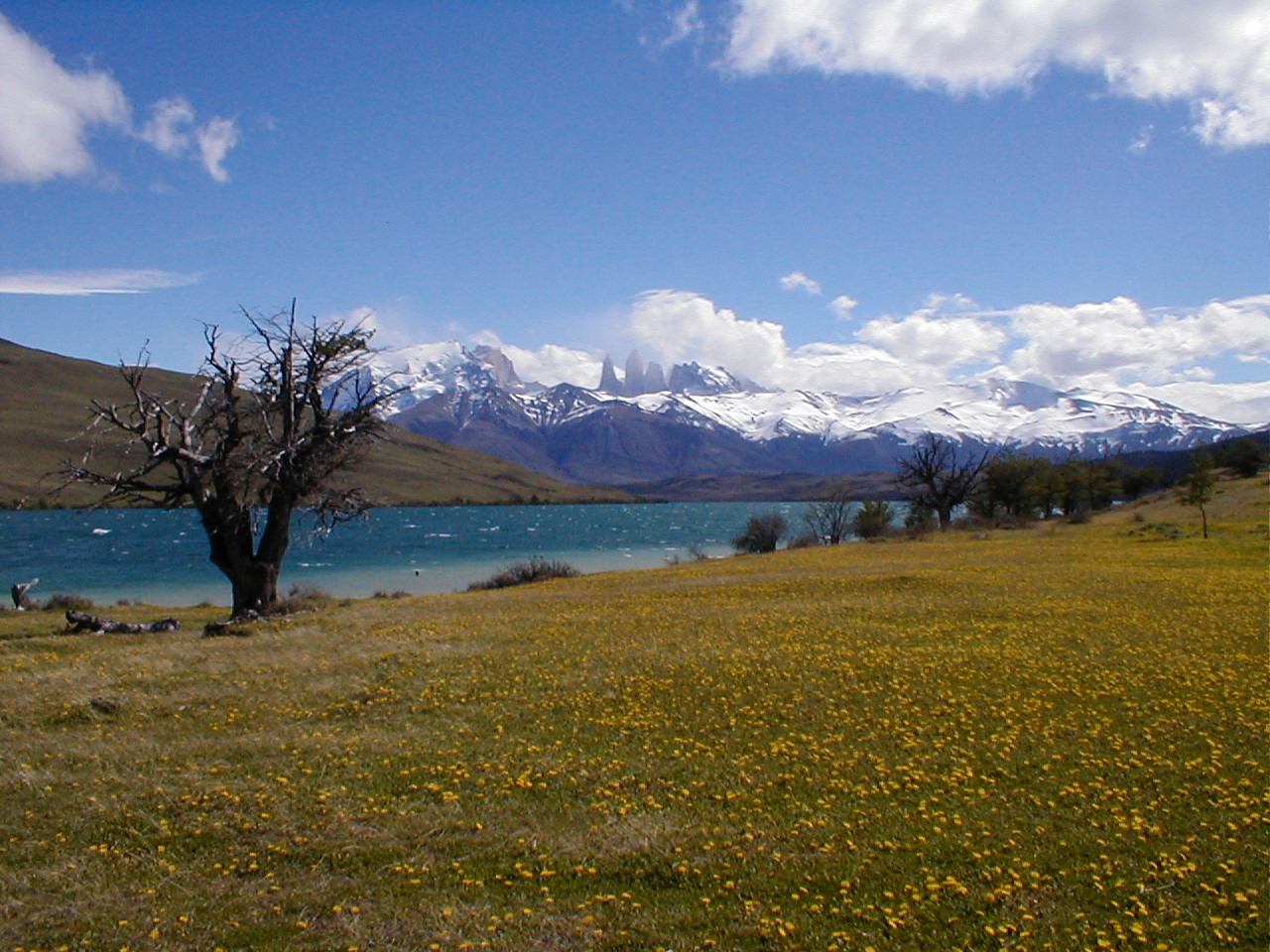
This morning on the CBC Radio One show The Current, I heard a piece about Douglas Tompkins, a San Franscisco millionaire. Seems he has been buying huge tracts of land in Chile and Argentina and turning them into nature reserves. Sounds great, no?

Not for everyone; the local people have big problems with this. So, here comes the rich, white, male foreigner into their country, buys their land, and tells them what to do with it. Not too crowd-pleasing. In some things I have heard, the media seems to be implying that the locals do not know enough about conservation, and this is why they disapprove of his project. How about the truth? That these countries are sick and tired of the West telling what to do, how to do it, and that they will be better off if they just listen. Sounds like the usual colonial, condescending attitude of the West to me.

Naturally, the local forest and other resource extraction industries are against this. But isn't it good to save the forests from destruction? But isn't it bad to take away the livlihood of the local people? Here we have the main problem in resource management.

My suggestion: by all means turn them into reserves, but the least he can do is help the government set up employment initiatives for jobs in or around the reserve, so that the locals will actually have a good reason to support it. As it is, they just see another white guy taking away their livlihood.

Having been in Environmental Studies for a few years now, it has come to my attention that the majority of the environmental movement (in Canada anyway) is middle class and white. Many such individuals (and this is a very general statement here, before anyone gets upset)are not able to see the vailidity in the above argument that I'm making. They would say that its our job to tell 'these people' how to take care of their environment....yes, the same people that live closer to it that we do by a mile. If Tompkins really wanted to help alleviate the situation, he could still create the reserves in close collaboration with local governments and the public to come up with a 'made locally' solution. But no, since its his money, he must have the final say on how it is spent, no? Ridiculous.

Here this segment of The Current here.

Thursday, September 28, 2006

Budget Cuts

In the wake of the recent Federal Conservative budget cuts (while agreeing to put about a billion toward the national debt), my partner wrote the following letter to the Toronto Star, which they published today:

Reassert values of social justice
Sep. 28, 2006. 01:00 AM
Tories cut $1B despite surplus
Sept. 26.


The announcements of budget cuts made by Jim Flaherty and John Baird clearly demonstrate they are still operating from the agenda of Mike Harris's Common Sense Revolution. The common sense being that the poorest and most in need do not matter. Program cuts to the unemployed, immigrants, those struggling with literacy and cuts to the advocacy of human rights for women, gays and minority groups. These are all programs aimed at improving access and opportunity for the marginalized. Failure to reinvest the vast surplus into education, housing, health and employment is grossly negligent.
It is time to give these bullies the boot and reassert the values of social justice and equality.

Chris Dowling, Toronto

Friday, September 22, 2006

Hugo Chavez Calls Bush the Devil

View the approx. 9 minute long video here of Chavez (President of Venezuela) recent remarks to the UN. He calls Bush the devil, saying that he can still smell the sulphur! He makes some excellent remarks about the global South: the Imperialist attitudes of the US, the fact that the South is waking up and mobilizing against it, and suggests that perhaps the UN should be moved to another county, one in the South.

OK, Venezuela is not perfect, but I love this man. He alone (with the exception of the leader of Iran) makes very pointed remarks about the US policy and Bush, without denigrating the US people themselves. It doesn't hurt that he is an excellent, and amusing speaker!

Sunday, September 17, 2006

Spacing Votes

The always excellent Spacing Magazine's site the Spacing Wire has just launched a sister site dedicated to public space issues in the upcoming election. A great way to keep up with these issues without having to wade through the rest of the election rhetoric.

Saturday, August 19, 2006

Yet Another Anti-War Rally

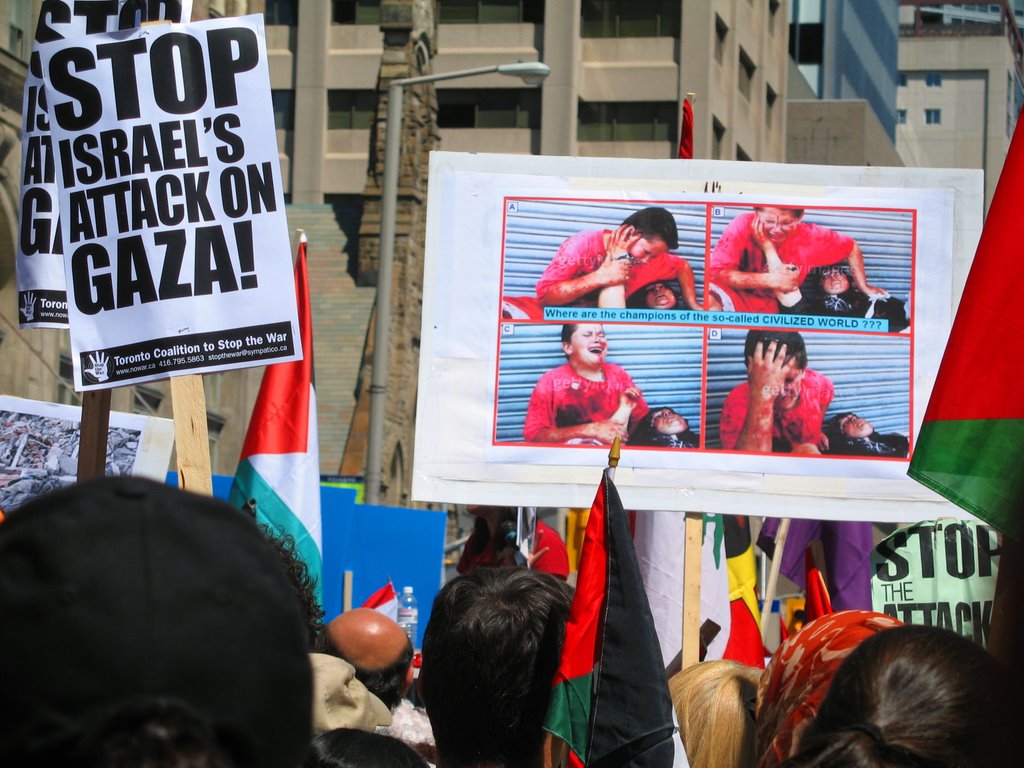
I believe that these weekly rallies have stopped because of the cease fire, although Israel has been at it again. These pics are from a rally a couple weeks ago.


Wednesday, August 09, 2006

George Galloway Interview

So refreshing to hear someone speak the truth about Israel being a terrorist state! See the approx. 9 minute long interview here.

Friday, July 28, 2006

Revue Film Society


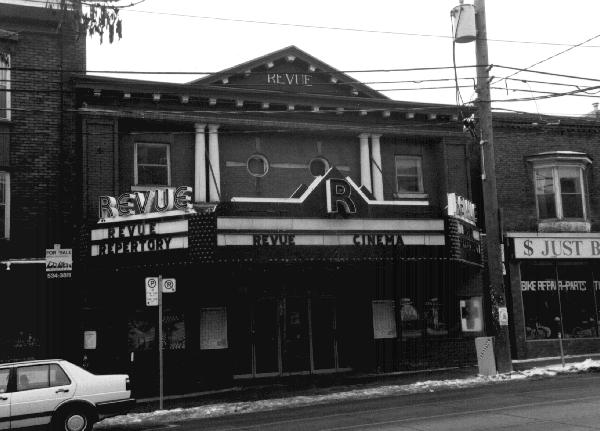
Although the Festival theatres have now closed, there is still hope. The Save the Revue society is trying to get people and funds together to reopen the Revue theatre and run it on a non-profit community basis. Sweet. They need to raise some funds by mid-August, so if 700 people contributed $20, it would meet the target! Please donate and learn more about the effort at the Save the Revue site. Tell all your friends! Why should we be forced to pay over $12 to see a movie?

Wednesday, July 26, 2006

Mass Anti-War Rally - July 22, 2006 - Post 2

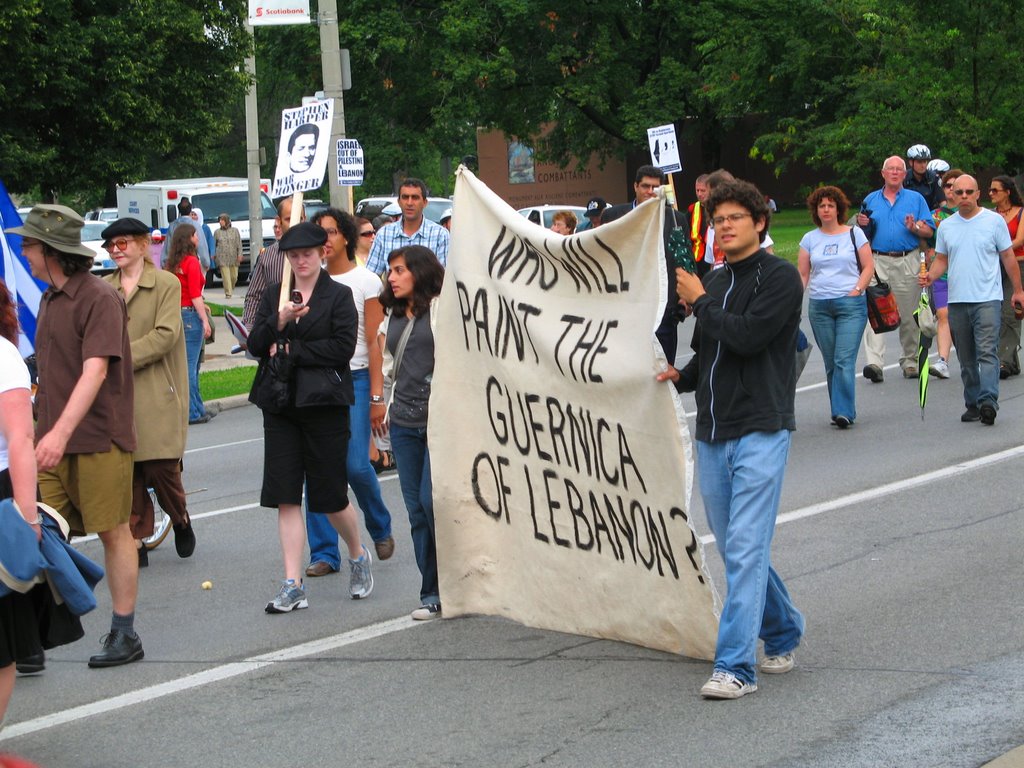
This is the second(last) post in a two post series of the rally. Chris almost got into it with someone, which was quite funny....we were waiting at a stop light when some white guy leaned out of his van and yelled at us "They're only trying to defend themselves!". Chris maintained his cool, but when another white guy in yet another van gave us the finger, he started to chase him! Unfortunately the light changed, so we'll never know what may have happened...

I believe that this is a Mohawk flag (readers, correct me if I'm wrong), but I just loved the look of it against the Toronto Hydro building at the corner of Queen's Park and University.


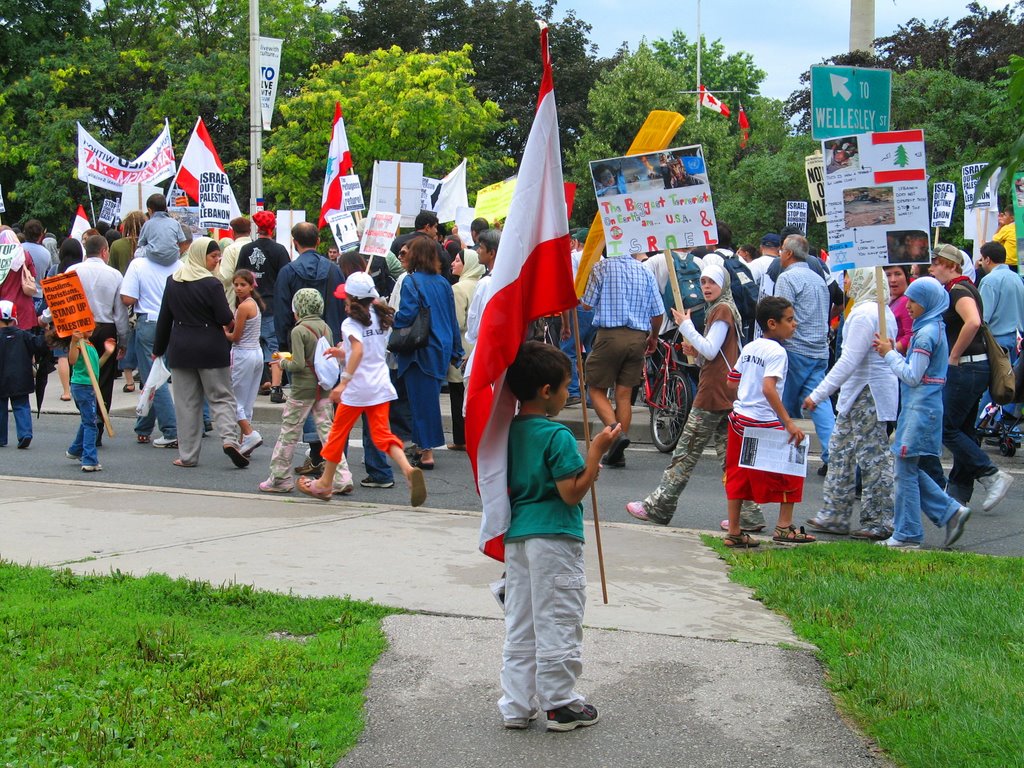
I love to see proud Palestinian children!


I must admit that I didn't know much about the whole Guernica thing before reading this sign....if you're in the same boat, look here.

I love this shot...this young boy looks so plaintive yet excited, invovled yet removed. Call it a study in opposites.

Mass Anti-War Rally - July 22, 2006 - Post 1

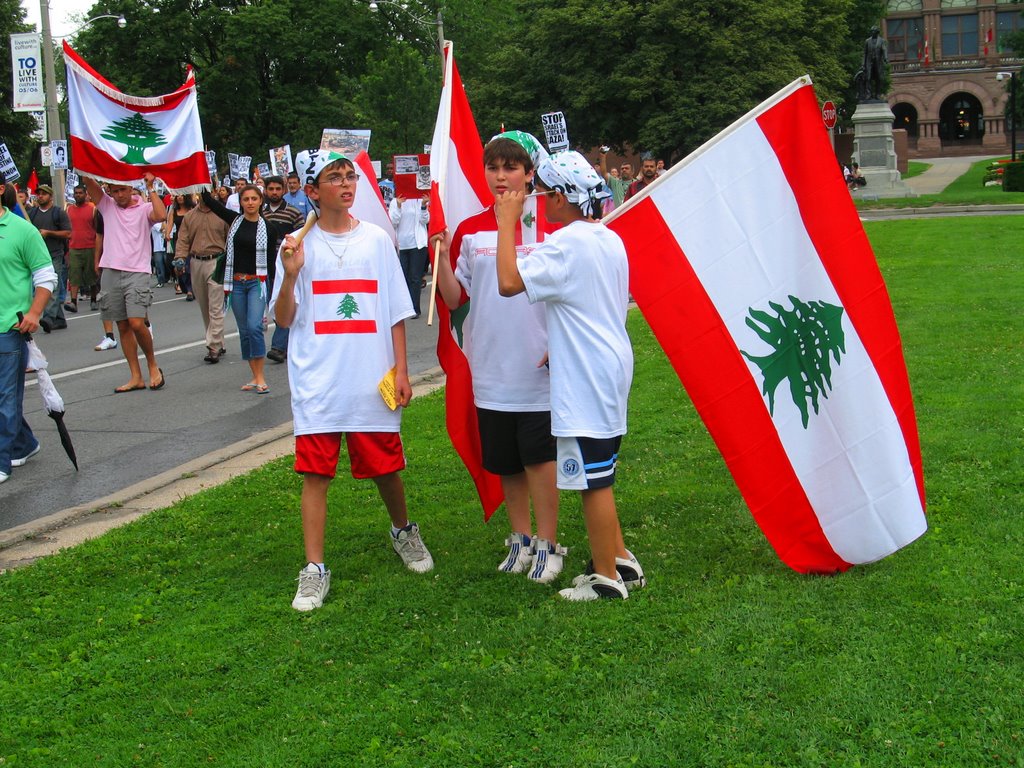
Chris and I attended a "get-the-hell-out-of Palestine-and-Lebanon" rally last Saturday. I was surprised at the turn-out, which, I hear, numbered about 10,000 people! This is the first in a two post series of pics of the rally.


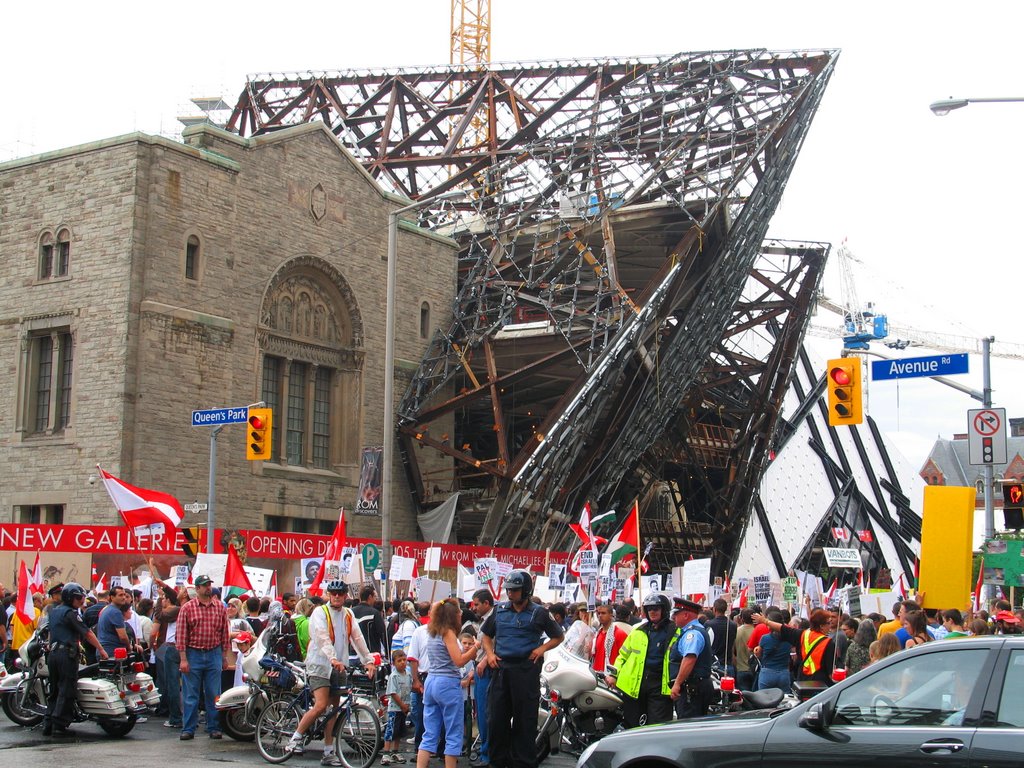
To me this is a quintessential Toronto picture: activism (the rally) alongside culture (the ROM).


Some signs didn't exactly make grammatical sense, but its the thought that counts!


This one is of the crowd in front of the ROM construction.

Thursday, July 20, 2006

Stop the (Middle East) War Rally - Saturday July 22!

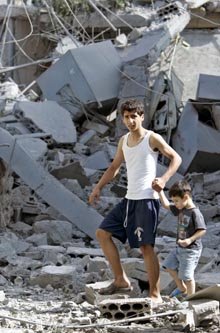
(photo of Lebanese village courtesy of CBC.ca)

Israel's actions making your blood boil? Feel the need to protest? In the Toronto area? Come on out to the rally this Saturday, organized by the Toronto Coalition to Stop the War. Here are the details:

MASS RALLY Saturday, July 221:00pmIsraeli Consulate180 Bloor Street West(west of Avenue Road, north side of Bloor)

The situation in the Middle East has rapidly escalated into an international crisis that threatens to pull the entire region into full-scale war. In response to the capture of one of its soldiers, Israel has attacked Gaza - bombing water and electricity stations, bridges, roads and other vital infrastructure, creating a humanitarian disaster for hundreds of thousands of people.

Israel has now spread its attack to Lebanon - bombing Beirut's international airport, major highways and other civilian infrastructure, at the same time issuing threats to Syria and Iran.Scores of innocent people in both Gaza and Lebanon have now been killed by Israeli bombs. These are war crimes.

Join the Toronto Coalition to Stop the War and its allies for an emergency public meeting on Monday night to discuss the growing threat of war throughout the region and what we can do to stop it. Then join us for a mass rally on Saturday to demand an immediate stop to Israel's attack on Gaza and Lebanon and to oppose an attack on Syria and Iran.

Organised byToronto Coalition to Stop the WarEndorsed byCanadian Arab FederationJewish Women's Committee to End the OccupationCoalition Against Israeli ApartheidMuslim Unity Group - TorontoFor more information or to endorse, please e-mail stopthewar@sympatico.ca.
Toronto Coalition to Stop the WarTCSW is Toronto's city-wide anti-war coalition,comprised of more than fifty labour, faith and community organisations,and a member of the Canadian Peace Alliance.www.nowar.ca stopthewar@sympatico.ca 416-795-5863